
Lower Cost or More Output
Next year's budget already carries the saving. The report of hours saved agrees with the budget. But the team is paid for the same hours as before and finishes the same amount of work. Nothing has been collected yet.
Definition
Harvesting is turning freed capacity into a result the accounts can show: the same work for fewer paid hours, or more finished work for the same paid hours.
The first is lower cost, and the second is more output. The other five outcomes spend freed capacity inside the operation.
More output shows as a smaller cost per finished piece of work, and as revenue where the work is sold. It counts only if a customer wanted the extra work. Work passed to a recipient at the next step does not count on its own.
The recognition pattern
- The saving is in next year's budget, and nobody can say which hours will stop being paid for.
- The saving is reported in hours. The cost is paid in overtime hours, contractor hours, shifts and staff posts.
- "We will absorb the growth" is the plan, and nobody has checked whether work is waiting that a customer wants.
What a harvest needs
Whole units
An insurance claims handler saves seven minutes on each simple claim. On our reasoning, not a finding, neither harvest can use those minutes until they add up to a whole unit.
Lower cost needs a unit the organization pays for: an overtime hour, a contractor hour, a shift, a post. More output needs one more finished claim that a customer wanted. Saved minutes produce that claim only where a handler has such claims waiting. But even then, other tasks can take them first.
Danish workers who used AI chatbots estimated they saved about 3% of their hours, and most spent the time on other tasks. Two years after ChatGPT's launch, earnings and hours had not measurably changed, and workplaces that encouraged chatbot use showed no difference in employment (Humlum and Vestergaard, 2025 and 2026).
Regrouping the work puts the minutes in one place, where they add up to hours the organization can stop paying for, or to more finished claims.
Measured freed capacity
In 2025 Commonwealth Bank of Australia declared 45 customer-service posts redundant after introducing an AI voice bot. The next month it reversed the decision. Its statement said the first assessment "did not adequately consider all relevant business considerations and this error meant the roles were not redundant". By the staff union's account, call volumes were rising at the time.
A vendor's estimate of hours saved is a forecast. Freed capacity is the time the operation measures as saved after the change, while service stays as good as before.
Demand decides which harvest is open
Claims pile up after a storm. Where work that a customer wants is waiting like that, or can be won, more output is open. Lower cost is open as well if the freed capacity adds up to a paid unit. Where nothing waits and none can be won, only lower cost is open, on the same condition.
Firms that invested more in AI between 2010 and 2018, before generative AI, grew sales and employment through new products, but the study does not show freed capacity supplying that growth (Babina et al., 2024). When cash machines reduced the number of tellers each branch needed, banks opened more branches, and teller employment held for years, though it is now falling (Bessen, 2015; US Bureau of Labor Statistics). More output lasts only as long as the demand behind it.
Where both are open, our reasoning is to put freed capacity on the waiting work while that work lasts and take what is then unassigned as lower cost. Lasting demand keeps the freed capacity; a backlog only borrows it.
What to stop paying for first
Overtime and contractor hours go first. They are the smallest units, and the easiest to restore if service slips. Posts go last, mostly by not replacing people who leave. The smallest-first order is our reasoning, not a finding.
Klarna's workforce fell from about 5,500 at the end of 2022 to about 3,400 two years later. Its US securities filing calls the fall a strategic decision to reduce its workforce using AI. Its chief executive says the fall came mostly by not hiring.
Not replacing people who leave needs no monthly decision, so unless someone tracks it against the freed capacity, it can outlast that capacity. Two studies find less hiring of young workers in AI-exposed occupations (Brynjolfsson, Chandar and Chen, 2026; Hosseini Maasoum and Lichtinger, 2026), but the Danish study finds no difference in young workers' hiring at workplaces that encouraged chatbot use.
Harvesting too early dries up the source
Analog Devices laid off nearly 12% of its people after a quality program freed capacity, and the program stalled (Sterman, Repenning and Kofman, 1997). The executive who led the program said people avoided improvements that might eliminate their posts. In the researchers' simulations, though, a rule against layoffs intensified the financial pressure at first, and outperformed the run with layoffs only after about three years.
First reinvest what the next improvement needs, as Capacity to Improve argues. Then take the rest.

What it costs
If a cut leaves too few paid hours for the work, service falls until the cut is undone or customers leave. Cuts in staff reduce customer satisfaction, most of all where a company had little spare capacity to begin with (Habel and Klarmann, 2015).
Freed capacity that nobody harvests or assigns goes wherever the work takes it.
Boundaries and distinctions
A budget rule is not a harvest. Writing the forecast saving into the budget is a default. In a harvest, someone measured the freed capacity and decided where it goes.
Cost avoided is not cash released. Not filling a post that a plan added avoids a cost never paid. When someone leaves, not replacing them lowers actual spending. Say which the business case counts. The example counts the second.
When cuts pay. At the 100 largest American industrial firms from 1977 to 1993, cuts in staff were more likely to improve performance when:
- the firm had a lot of spare capacity;
- the cut came with a redesign of the organization, not as a reduction in staff alone;
- the cut was made while performance was stable or improving (Love and Nohria, 2005).
Across 114 studies, cuts in staff show little evidence of long-run gains, though much of the underlying data is old (Steel and House, 2024).
The growth case rests mostly on companies' own accounts. Wiremold's chief executive says growth absorbed the people that improvement freed. By the same account, though, the no-layoff pledge followed an early retirement offer that about a third of its people took, and part of the growth was bought (Byrne, 1995 and 2019).
Example
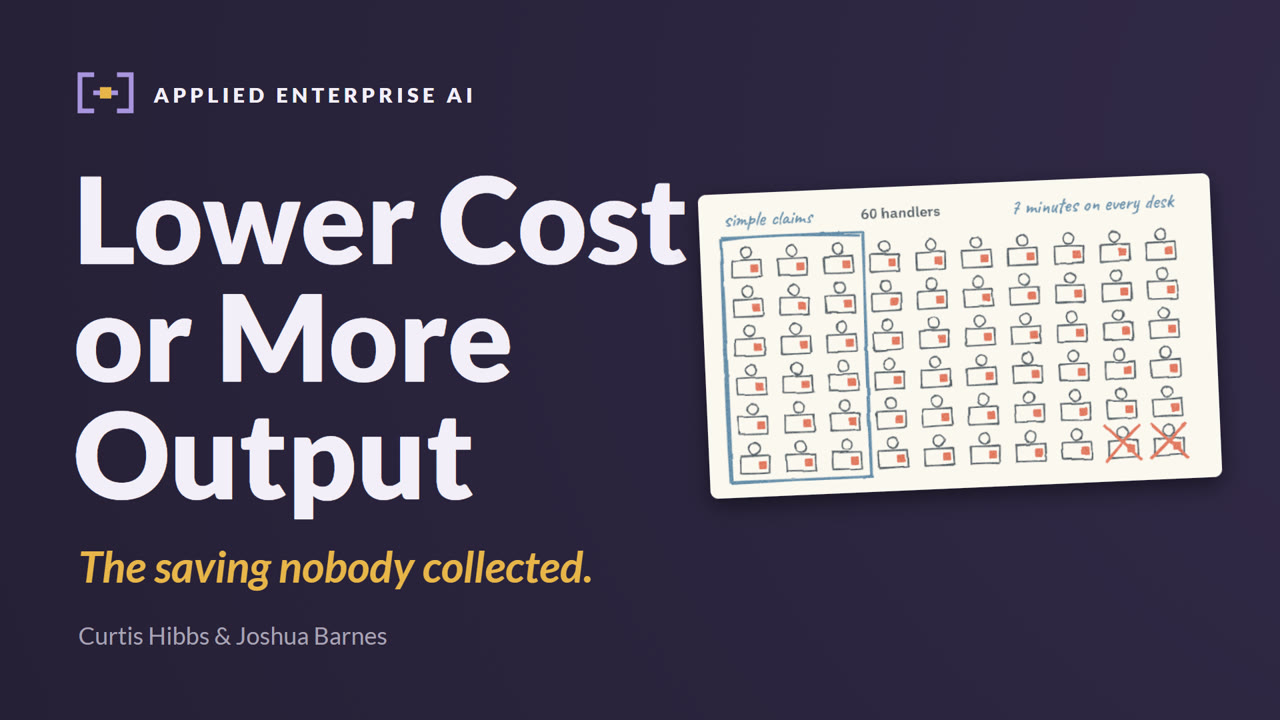
In the constructed claims operation from Where Freed Capacity Goes, next year's budget assumes six fewer handlers out of sixty, because the vendor's forecast went straight in.
A month of timings shows about seven minutes saved on a simple claim and almost nothing on a complex one. Across the team, that adds up to roughly four handlers' time, not six. And no single handler is free.
A storm-season backlog is waiting, and claimants, the customers, want those claims settled. But a complex claim waits for a senior adjuster, the recipient of the handler's file, so only the simple backlog can be settled faster (Faster Delivery).
So the operation regroups, putting simple claims with a smaller group of handlers. Ending the Saturday overtime takes about one handler's time, permanently, and is the first lower cost. Preparing complex files for the senior adjusters takes about one, also permanently, and is the reinvestment: what the next improvement needs. The other two clear the simple backlog.
Once the backlog is gone, about two handlers' time is left unassigned. For a quarter, the operation holds it in reserve, handling claims as if two posts were unfilled. If the share of claims reopened and the time to settle a claim both hold, the posts of the next two handlers who leave stay unfilled. The budget line changes from six fewer handlers to two.
The change has worked if the backlog is gone, both measures hold, and spending matches the corrected budget.
Applied test
- Take one reported saving that a budget or business case depends on. Is it measured in your operation, or forecast?
- Does the freed capacity add up, in one place, to an hour, shift or post you can stop paying for, or to more finished work a customer wants? If not, what regrouping would?
- Is work waiting that a customer wants, or can more be won?
- If you choose lower cost, name what you will stop paying for, smallest unit first, and the service measure that would show you cut too far.
- Before taking anything, decide what the next improvement needs, who owns the decision, and when the decision is reviewed.
If you cannot change the budget yourself, take your answers to whoever can.
Sources and lineage
Lower Cost or More Output is part of Applied Enterprise AI, a body of work developed by Curtis Hibbs and Joshua Barnes. Putting freed capacity into the next improvement first comes from Applied End-to-End Flow. The page also draws on:
- Anders Humlum and Emilie Vestergaard, Large Language Models, Small Labor Market Effects, 2025, and Still Waters, Rapid Currents, 2026 (working papers).
- Finance Sector Union, statement of August 21, 2025; Information Age, August 2025 (Commonwealth Bank of Australia).
- Babina, Fedyk, He and Hodson, Artificial Intelligence, Firm Growth, and Product Innovation, Journal of Financial Economics, 2024.
- James Bessen, Toil and Technology, Finance and Development, 2015.
- US Bureau of Labor Statistics, Tellers, Occupational Outlook Handbook.
- Klarna Group plc, Form F-1, US Securities and Exchange Commission, March 14, 2025.
- Brynjolfsson, Chandar and Chen, Canaries in the Coal Mine?, 2026; Hosseini Maasoum and Lichtinger, Generative AI as Seniority-Biased Technological Change, 2026 (working papers).
- Sterman, Repenning and Kofman, Unanticipated Side Effects of Successful Quality Programs, Management Science 43(4), 1997.
- Habel and Klarmann, Customer reactions to downsizing, Journal of the Academy of Marketing Science 43, 2015.
- Love and Nohria, Reducing Slack, Strategic Management Journal 26(12), 2005.
- Steel and House, Short-term pain for long-term gain?, Frontiers in Behavioral Economics 3, 2024.
- Art Byrne, How Wiremold Reinvented Itself Through Kaizen, Lean Enterprise Institute, 1995; Art Byrne, Ask Art, Lean Enterprise Institute, December 13, 2019.