
Value Maxxing
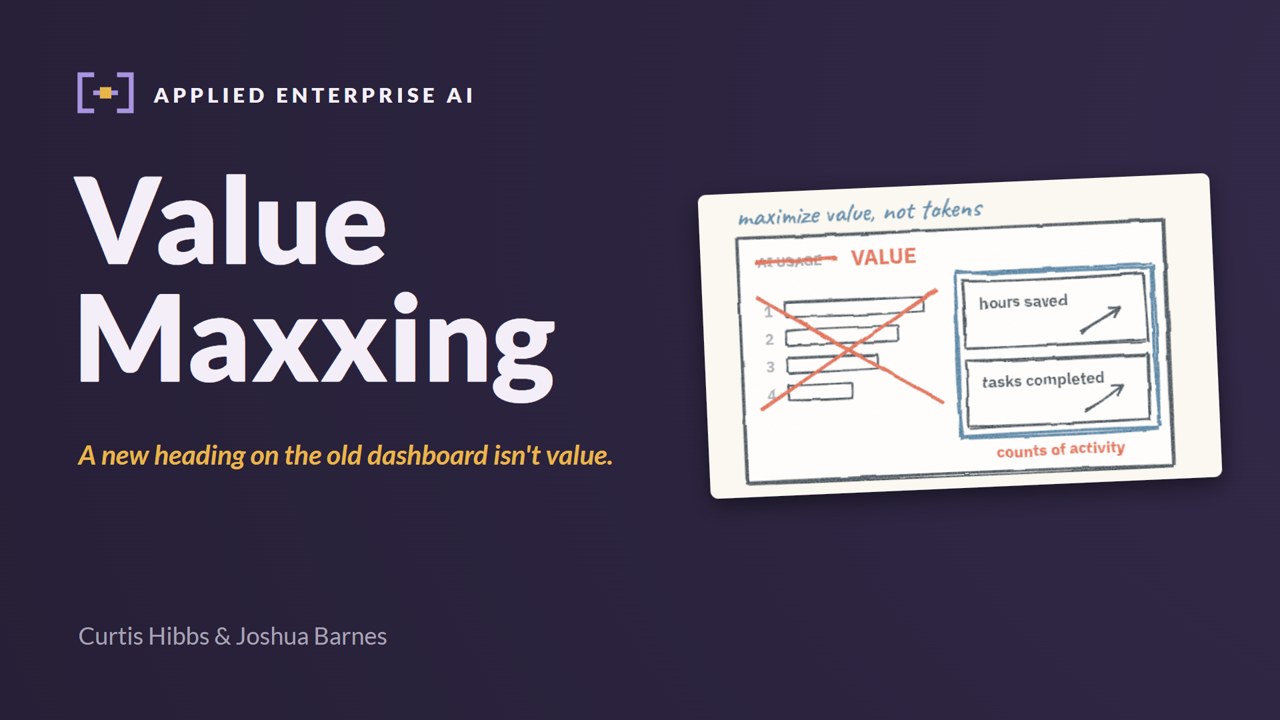
The usage leaderboard is gone. The new instruction is to maximize value, not tokens. The dashboard shows the same hours saved and tasks completed, under a new heading.
What value maxxing is
Value maxxing is making every decision about an AI effort answer to what the effort does for the customer, counted for each completed unit of work, at its full cost, with the harm it does or risks counted against it.
- For the customer. The customer is the person or organization whose outcome the whole flow of work serves. Each step's output goes to a recipient, who may be a colleague. A better result for the recipient is evidence, not yet value.
- For each completed unit. A completed unit is one finished piece of the work, such as a settled claim or a delivered quote. A seat, a token, a prompt or a draft is not a completed unit.
- At full cost. The cost is the bill for seats and tokens plus the time that people spend checking the result, correcting it and keeping the tool running. The invoice shows the bill and none of the time.
- With harm counted against it. Harm is what a customer or the organization has lost, or could lose, through what the effort produced or did. Harm done that the organization pays for goes into the full cost; harm done that it never pays for sits beside the gain, and so does harm risked. A gain reported with no harm beside it shows one side only.
The four parts are judged together, not combined into one figure. The terms of that judgment, not its result, are set in advance in the effort's stop rule. The rule sets out the target that the customer's outcome must reach; what one completed unit costs, read beside that target; and the harm that would end the effort. Three things on this page are our own and untested: the definition with its four parts; the two kinds of harm and the reasons harm goes uncounted; and the seven decisions as a set.
In 2026 some companies ranked or rewarded staff by how much AI they used, and the practice came to be called tokenmaxxing. Some Amazon employees told 404 Media they had deliberately gamed an internal usage leaderboard. Amazon closed the board, saying the board had served its purpose of encouraging AI use. A memo from an Amazon engineering leader called usage numbers "deeply flawed" and cautioned against making them targets. Meta told its managers it would not judge impact by adoption dashboards or token counts, as The Information reported.
A correction then circulated under the name valuemaxxing: measure outcomes, not consumption. But the two published definitions cited below count tasks completed and hours saved among the outcomes. Those are counts of activity and output. Under such a definition, the old dashboard qualifies. Under this page's two-word term, value maxxing, it does not.
The part most often left out
A wrong result reaches a customer. Data goes somewhere it should not. An action runs that cannot be undone. Each of those is harm, and harm comes in two kinds. Harm done has already happened. It is counted once, through costs such as refunds, rework and correction, which go into the full cost of the completed units it touched. Harm risked has not happened yet, so nothing has been lost; it sits beside the gain as what could still be lost. A rare, large failure is missing from every average until the day it occurs. Harm done that the organization never pays for, such as a customer's loss not made good, has happened but is in no cost, so it is counted beside the gain.
86% of CIOs told Gartner that AI risk is growing faster than AI value in their organization. That is their view of their own organizations; it does not measure harm.
Harm goes uncounted for three reasons:
- The gain shows up at once, in the effort's own report. The harm shows up later and somewhere else, often in another team's budget.
- The usual count of failures tracks repairs, not harm, as Measuring AI-Enabled Work shows. That count says how often something was fixed, not what a failure cost the customer or what went unrepaired.
- The people who report the gain are seldom the people who would bear the harm.
To bring harm into the count, take one effort. Name the worst failure that could plausibly happen, and who would bear it. Then ask how long the failure would run before anyone noticed, and whether its effects could be undone. Decide how much harm, done or risked, would end the effort, and write that into its stop rule, agreed before the effort is funded. For the agreements that contain a failure in live use, see Dependable in Production.
Counting harm is not refusing risk. An effort can be worth a known risk of harm. If harm risked is left uncounted, the decision to continue or expand the effort rests on the gain alone.
Seven decisions
Some of the seven decisions below are left to a default that nobody chose; others are made on some basis other than value.
| Decision | The default | The practice | Where it is worked out |
|---|---|---|---|
| What to judge by | The step got faster | The customer's outcome, with the recipient's result as evidence | The two tests; Measuring AI-Enabled Work |
| What a result costs | The bill for seats and tokens | The cost of one completed unit, before and now | Knowing Whether It Pays |
| What to do with usage numbers | Rank and reward them | Watch them; attach no reward | Measuring AI-Enabled Work |
| Which arrangement to build | An agent, because agents look like progress | The simplest arrangement that does the job | Vision, path, and means |
| Speed up or redesign | Faster work in an unchanged process | Redesign when the customer's wait must fall by more than the faster step can save | Redesigning the Work; Faster Delivery |
| Where saved time goes | Wherever it drifts | A decision, made before the time is saved | Where Freed Capacity Goes |
| When to stop | Never; add another pilot | A stop rule agreed before funding; scale what has shown value | Picking and Stopping AI Efforts; Where AI Stalls |

What to judge by. Hours saved show activity. They are a claim about time, and they bear on cost only once they show up in what a completed unit costs. They say nothing about the customer's outcome, which still has to be measured.
What a result costs. Compare what one completed unit costs now with what it cost before. Read that comparison together with how far the customer's outcome has moved from its baseline.
What to do with usage numbers. A usage number is a signal that needs explaining: low use may point to missing access, to stalled use, or to a tool that does not fit the work. Once the number is rewarded, people produce it, and real use can no longer be told apart from use produced for the reward.
Which arrangement to build. Neither the number of agents nor their autonomy measures progress, and more autonomy widens what can go wrong while nobody is watching. The simplest arrangement that does the job may be any of four: conventional automation, a fixed sequence of AI steps, an autonomous agent, or a person working with AI assistance.
Speed up or redesign. A faster task can leave the customer waiting exactly as long as before. A faster step can shorten that wait by no more than the time the step itself takes, and only if the work after the step keeps up. If the customer's wait has to fall by more than the faster step can save, the work around the step has to change; when the wait need not fall by more than that, speeding up the step alone can be enough.
Where saved time goes. Saved time is capacity, not yet a result. If nobody decides what it buys, a default does: a budget reduced by the amount saved, or other work that fills the hours.
When to stop. A stop rule names the harm that would end the effort, as well as the target the effort must reach. Gartner reports that the average organization increased its number of AI use cases by more than 400% in a single year. A growing count cannot say which use cases to keep; each is an AI effort and needs its own stop rule.
What value maxxing is not
- Not cost cutting. The same needed outcome at a lower full cost is value. Lower cost by itself is not: a cheaper result that the customer did not need is not value. Instead of a smaller budget, a gain can go to growth or better service.
- Not less AI use. Minimizing tokens makes the same mistake as maximizing them, because both steer by consumption, a measure of activity. Exploring what AI can do earns its place when the exploration looks for ways to improve a customer's outcome, has a budget, and feeds its findings into what gets funded next.
- Not a demand for early returns. Gains from redesign arrive late, and the measured outcome can dip first, while the redesign settles in. Write the date the gain is due into the stop rule, so an early dip is read against it.
- Not volume. More use cases, more agents and more output are counts of activity and output.
Applied test
Take one AI effort you are responsible for.
- Who is the customer, and which outcome of theirs should move? How far has it moved from its baseline, or, if the effort has not run yet, how will its movement be measured?
- What is one completed unit, and what does it cost now, compared with what it cost before?
- Which numbers in the effort's report are usage or output?
- What is the worst failure that could plausibly happen, who would bear it, and is that harm counted in the effort's cost or set beside its gain?
- Which of the seven decisions was never made, or was made on some basis other than value, and who can make it?
- What shortfall against the target, measured at what date, would end the effort? What harm, whenever it occurred, would end the effort?
If either of the first two has no answer, start there. If a decision is not yours to make, take your answers to whoever funds the effort.
Sources and lineage
Value Maxxing is part of Applied Enterprise AI, a body of work developed by Curtis Hibbs and Joshua Barnes. It draws on:
- Adam McDaniel and Markus Eisele, "Tokenmaxxing is dead, long live valuemaxxing", IBM, June 2026. IBM credits the word "valuemaxxing" to Marc Boroditsky of Nebius.
- Keri Allan, "From tokenmaxxing to valuemaxxing", ITPro, September 2026, on tokenmaxxing as a named practice.
- Pramit Marattha, "Tokenmaxxing to valuemaxxing: What every IT and finance leader needs to know", Flexera, October 2026. IBM's and Flexera's are the two definitions of valuemaxxing that this page describes.
- Gartner, "AI Success Depends on Managing Risk, Not Just Creating Value", October 2026, for the two figures, which are Gartner's own.
- Curtis Hibbs and Joshua Barnes, "Count AI Use. Don't Reward It.", November 2026, for the Amazon and Meta cases, which rest on the reports cited there.