
The Value-Risk Flywheel
Two meetings discuss the same AI effort. In the first, the review step is the reason it is slow. In the second, the review step is the reason it is safe to run. Each meeting ends with its own list of actions.
What the flywheel is
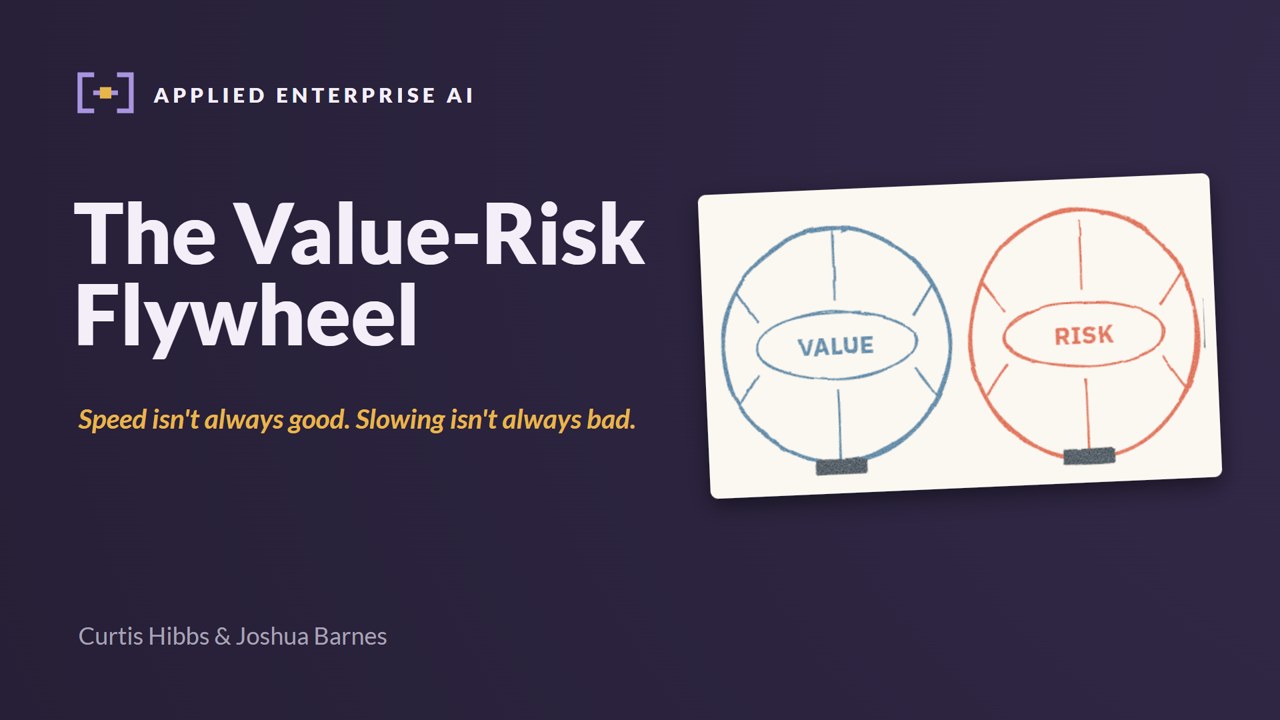
The Value-Risk Flywheel is Gartner's picture of an AI effort as two wheels that turn together, one for value and one for risk, each shaped by what speeds the effort and what slows it.
Gartner analysts Daryl Plummer and Kristin Moyer introduced it in October 2026, as a way to see value and risk as connected rather than opposed.
- In Gartner's word, gains and failures compound. A gain on the value wheel makes the next gain easier, and a failure on the risk wheel makes the next failure more likely.
- The two wheels need not carry equal weight. Gartner names three shapes: value-heavy, neutral and risk-heavy. In the keynote that Plummer and Moyer gave on October 19, 2026, a flywheel is neutral when value and risk compound equally. On our reading, value-heavy means value compounds faster, and risk-heavy means the reverse. Which shape is right depends, in Gartner's view, on the organization's strategy and on how much risk it will accept.
- In their keynote, Plummer and Moyer said a flywheel can be drawn at more than one level, such as a technology, a project or a whole business.
The flywheel is Gartner's. Ours are the examples, the steps for drawing one, and the reading of the value-heavy and risk-heavy shapes. In the table below, the words in each cell that say which items go there are ours too. So is the pairing of each cell with a page that tests what belongs there.

Four forces
Both meetings agree that the review step slows the effort. They disagree about whether that is good. Both have a point: the review step slows the value wheel by delaying the customer's outcome, and slows the risk wheel by catching errors before they do harm. Speeding the effort up can turn both wheels faster, because more output reaches the customer sooner and more can go wrong before anyone looks.
Gartner names two forces that shape the flywheel. Momentum speeds outcomes, and drag slows them. Neither is good or bad in itself. As Daryl Plummer puts it in Gartner's press release dated October 19, 2026, "momentum itself is not always good, and the right kind of drag can be beneficial."
So momentum and drag each come in a good kind and a bad kind, which makes four forces in all. Gartner's own lists put trust, reuse, work redesign and scaling proven successes under good momentum, and governance, security, accountability and spending discipline under good drag.
| Momentum (speeds outcomes) | Drag (slows outcomes) | |
|---|---|---|
| Good | Value that makes the next gain easier: a redesign that removes a wait, a proven effort scaled up, an evaluation that later work can reuse. See Redesigning the Work and Value Maxxing. | Slowing that protects more than a faster arrangement would: a stop rule, a review that catches the errors that would cost most, time for people to learn the changed work. See Picking and Stopping AI Efforts, When Human Review Helps and Skills, Managers and Trust. |
| Bad | Activity that grows without producing a gain: use cases counted as progress, AI use rewarded, output that nobody is waiting for. See Measuring AI-Enabled Work and Where AI Stalls. | Slowing that protects no more than a faster arrangement would: a rule that has outlived its reason, a person checking every output when the checks no longer catch errors. See Reviewing AI Rules and What Replaces Reviewing Everything. |
For a review step, the faster arrangement is its best alternative, such as review of a sample or an automated check. A review step is good drag where it protects more than its best alternative would, and bad drag where it protects no more than that alternative would. Like the review step, any item can sit in different cells in different efforts.
Bad momentum looks like progress on a report, and good drag looks like delay. So an item's appearance cannot sort it, but a test can, and each cell names the page that shows how.
Drawing one
To draw a flywheel for one AI effort:
- On the value wheel, write the customer's outcome that the effort is meant to improve. On the risk wheel, write the harm that the effort could do.
- List what is speeding the effort up.
- List what is slowing it down, including every control on it, such as a rule, a review step or an approval.
- Sort every item from both lists into one of the table's four cells. An item that speeds the effort is good momentum if it is value that makes the next gain easier, and bad momentum if it is activity that grows without producing a gain. An item that slows the effort is good drag if it protects more than a faster arrangement would, and bad drag if it protects no more than a faster arrangement would. Mark the items that you cannot sort, and the items that two people sort into different cells.
- Take the marked item that puts the most harm or value at stake if it is sorted wrongly. If nothing is marked, choose the same way from all the items. Test which cell it belongs in, using the pages that the table names.
The finished drawing is the two wheel entries and, beside them, the four cells with their items and the marks from step 4. It needs no scores.
Drawn by one person, a flywheel shows that person's view. Drawn together by the people who want the effort faster and the people who want it safer, it shows where they disagree.
Worked flywheels
Each flywheel below is our sorting of one kind of AI effort, not a measurement of any actual effort, and more will be added over time.
1. Software development with coding agents
- The effort. Coding agents that write and change software. The value wheel holds working software that reaches customers sooner, and the risk wheel holds errors that reach them. Software development is Gartner's own example of a flywheel where value can compound faster than risk.
- Good momentum. Working prototypes in place of proposals, and automated tests and evaluations that later work reuses.
- Bad momentum. More code than anyone can review, and code changes counted as progress.
- Good drag. Review of the changes where an error would cost most, plus automated tests and acceptance criteria.
- Bad drag. Every change waiting in one queue for the same check. For changes that could do no harm, the wait protects nothing.
- What decides, and what is not known. Whether review and integration (combining the changes into the working software) can keep up with what the agents produce. If review and integration cannot keep up, faster coding can leave the customer waiting as long as before (Faster Delivery). Not known: how much of the gain is real. In one randomized study of experienced open-source developers, tasks on which AI tools were allowed took 19% longer. Yet afterwards the developers judged that AI had sped them up by about 20% (METR, 2025).
2. Rewarding staff for AI use
- The effort. Ranking or rewarding staff by how much AI they use. A reward for use names no customer outcome for the value wheel. The risk wheel holds what the organization loses through AI use undertaken only to earn the reward.
- Good momentum. Little, since the reward speeds AI use but nothing ties that use to a customer outcome.
- Bad momentum. Use produced for its own sake. Some Amazon employees said they had gamed an internal AI usage leaderboard. Duolingo's chief executive said that when AI use briefly counted in performance reviews, staff asked whether they were supposed to use AI just for the sake of it (Count AI Use. Don't Reward It.).
- Good drag. Removing the reward, which slows the growth in use undertaken only to earn it. The count of AI use stays, as a signal: low use can point to people without access, or to places where use has stalled.
- Bad drag. A rule that caps use without asking what the use produced.
- What decides, and what is not known. Whether a reward is attached to the count of AI use. Not known: the effect on the business. Neither account reports a measured effect, in either direction.
3. Human review of AI output
- The effort. A person approves each AI draft before it is passed on. The value wheel holds correct work reaching the customer, and the risk wheel holds errors that get past the review.
- Good momentum. Errors caught early teach the people doing the work and improve the rules that the AI works under.
- Bad momentum. An approval rate that climbs because reviewers have begun to check less carefully.
- Good drag. Review that protects more than its best alternative would (When Human Review Helps).
- Bad drag. Review of every draft when there are more drafts than the reviewers can check carefully. The overload can leave the review protecting no more than its best alternative would, because the reviewers keep up only by checking less carefully (What Replaces Reviewing Everything).
- What decides, and what is not known. Trying this review and its best alternative on the same work. Not known: whether a given review step protects more than its best alternative, until the two have been tried.
What the flywheel does not tell you
- It measures nothing. Calling a flywheel heavy on value is a judgment until value is defined and harm is counted. Value Maxxing does both for one effort.
- It does not sort the forces for you. Telling good drag from bad drag, or good momentum from bad momentum, takes a test.
- "Compounding" comes with no measured rate. CIOs told Gartner that, on average, their AI risk is growing four times faster than AI value. That sounds like a rate, but it is what CIOs report about their own organizations, not a measurement. Gartner's public account gives no sample for it.
- It is a way to see and discuss an effort, not a design method. Nothing public tests whether using the flywheel changes results. What this page adds is ours and has not been tested either.
Applied test
Draw the flywheel for one AI effort that you answer for, with one person who wants it faster and one who wants it safer. Count the items that the two of them sort into different cells. Of those, take the item that puts the most harm or value at stake if it is sorted wrongly. If the two agree on every item, choose the same way from all the items. In the table, find the page that tests it, then agree who will run the test. If the decision about that item is not yours, take what you find to whoever has the authority to decide.
Sources and lineage
The Value-Risk Flywheel page is part of Applied Enterprise AI, a body of work developed by Curtis Hibbs and Joshua Barnes. It draws on:
- Gartner, "Gartner Says AI Risk is Rising Faster Than AI Value", press release, October 19, 2026.
- Gartner, "AI Success Depends on Managing Risk, Not Just Creating Value", October 19, 2026. The Value-Risk Flywheel is Gartner's framework, set out in these two pages, which were read in full; Gartner's client research on it was not read.
- Daryl Plummer and Kristin Moyer, Gartner analysts, opening keynote of Gartner IT Symposium/Xpo, October 19, 2026. The keynote was read from a recording of its first half.
- Becker, Rush, Barnes and Rein, "Measuring the Impact of Early-2025 AI on Experienced Open-Source Developer Productivity", METR, July 2025.
- Curtis Hibbs and Joshua Barnes, "Count AI Use. Don't Reward It.", November 2026, for the Amazon and Duolingo accounts, which rest on the reports cited there.