
The Working Model
AI has made one stretch of the work very fast, and the customer is still waiting. Look for a question nobody answered, or one a default answered. AI changes the answers, not the questions.
What the working model is
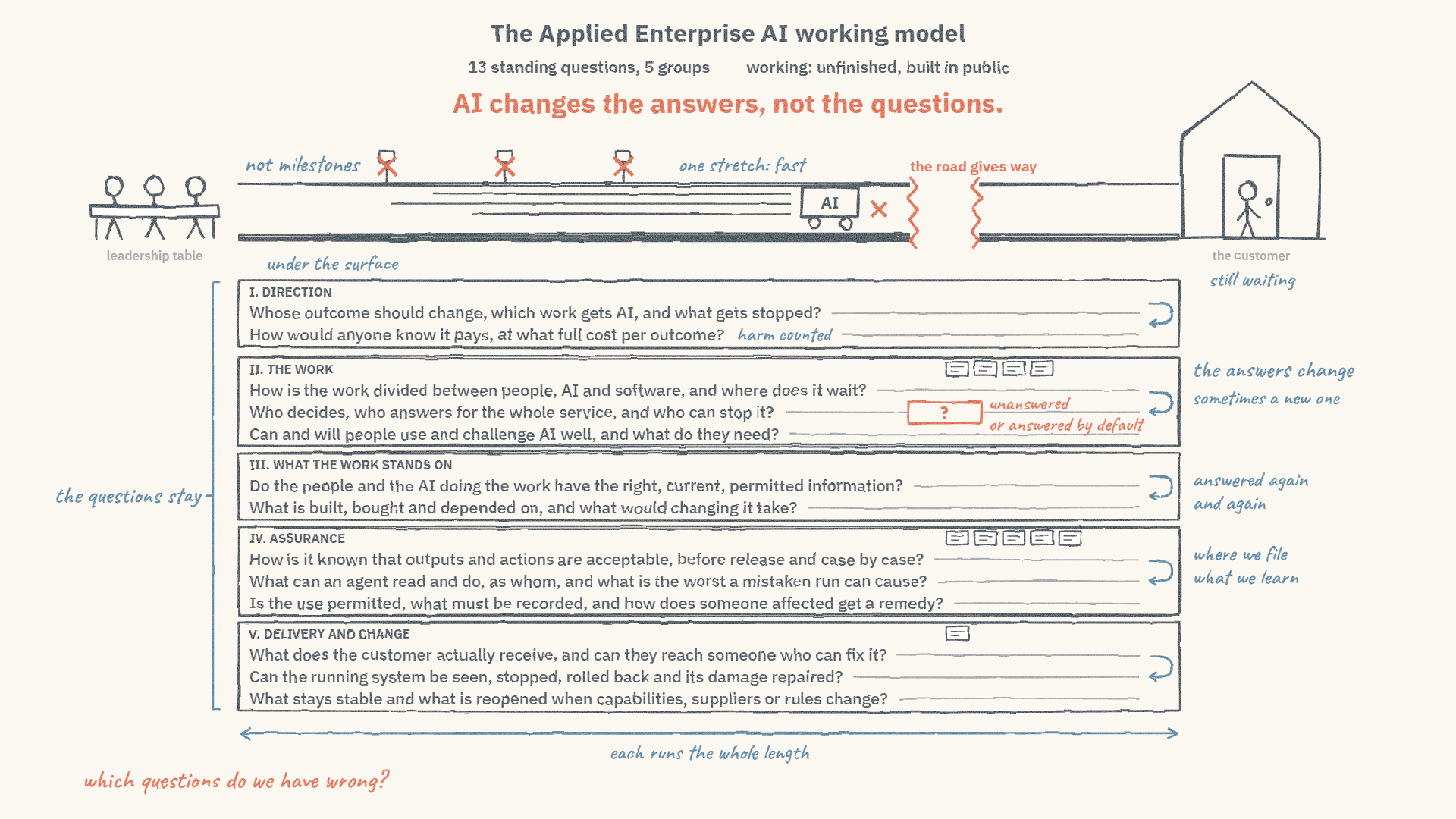
The Applied Enterprise AI working model is a map of the thirteen standing questions an organization has to keep answering for AI-enabled work to deliver value to its customers.
A standing question is never settled once and for all. Each question asks for a decision. A five-person firm and a bank face the same thirteen questions and answer them very differently.
Picture the work as a road from a leadership table to a customer's door. The thirteen questions sit in five groups, ordered from deciding what the work is for to what the customer receives. Each group lies under the road's whole length, like a layer. The final group includes keeping the work's design current.
The thirteen questions and their grouping are our own, and they have not been tested as a set. The working model is at version 0.1 and will change. The section Built in public says how.
The map
The order of the table is not a sequence of steps.
| Group | # | The standing question | Where to go |
|---|---|---|---|
| Direction | 1 | Whose outcome should change, which work gets AI, and what gets stopped? | Picking and Stopping AI Efforts |
| 2 | How would anyone know it pays, at what full cost per outcome? | Knowing Whether It Pays; Measuring AI-Enabled Work; Value Maxxing | |
| The work | 3 | How is the work divided between people, AI and software, and where does it wait? | Redesigning the Work; Where Freed Capacity Goes and its five pages, starting with Faster Delivery |
| 4 | Who decides, who answers for the whole service, and who can stop it? | Who Owns the AI Decisions; Who Owns Whether Review Works? | |
| 5 | Can and will people use and challenge AI well, and what do they need? | Skills, Managers and Trust; Who Will Be Qualified to Review? | |
| What the work stands on | 6 | Do the people and the AI doing the work have the right, current, permitted information at the moment of work? | Readiness of Data and Integrations |
| 7 | What is built, bought and depended on, and what would changing it take? | No page yet | |
| Assurance | 8 | How is it known that outputs and actions are acceptable, before release and case by case? | Who Is in the Loop? and its pages; Dependable in Production |
| 9 | What can an agent read and do, as whom, and what is the worst a mistaken or manipulated run can cause? | Agent Access and Hidden AI Use; Governing Shadow AI | |
| 10 | Is the use permitted, what must be recorded, and how does someone affected get a remedy? | No page yet | |
| Delivery and change | 11 | What does the customer actually receive, and can they reach someone who can fix it? | No page yet |
| 12 | Can the running system be seen, stopped, rolled back and its damage repaired? | No page yet | |
| 13 | What stays stable and what is reopened when capabilities, suppliers or rules change? | Reviewing AI Rules |
Two pages cut across several groups. Where AI Stalls checks eight of these questions for an AI effort that has stalled. The Value-Risk Flywheel sorts what speeds an AI effort from what slows it. Four questions have no page yet. That is where our knowledge is thinnest.
Why the questions last
The questions persist while their answers move. Railroad and telegraph, electrification, mainframes, enterprise software and the internet each relaxed a constraint and changed which answers to these questions worked best. None removed a question. The gains from each technology came late, after the work surrounding it had changed. Our review of the history of organization design supports each of these points, with evidence mostly from the United States and Europe.
The questions press harder as more actors depend on each other's work. Those actors can be people, teams, suppliers or AI agents. Conflicting interests, the limits of one person's attention, and uncertainty also make the questions harder to answer. AI can add actors without adding people: one person can run several AI agents. That person has to specify the work, pass context, check the output and limit what each agent may do. For people and teams, the same review supports this claim in part, but for AI agents it is our conjecture.
Reading a question
- What kind of change AI brings to it. AI can make an existing step faster, change the work surrounding that step, or make a new outcome feasible. Ask which constraint on this question's answer has fallen, and what is now worth doing.
- Whether its answer delivers value, with harm counted. Start with the two tests of effectiveness: did the work produce something acceptable, and what did that output do for the customer? Value is the customer's outcome, for each completed unit of work, at full cost, weighed against harm done and harm risked. As Value Maxxing sets out, the outcome, the cost and the harm are judged together, not combined into one figure. The working model looks for that harm through four lenses: safety, transparency, accountability and fairness. When two lenses ask for things that conflict, whoever has the authority to answer this question settles the trade-off for the case in hand, and records it.
- How fast its answer should change. An answer should change no faster than evidence arrives to justify the change. AI sped up execution, but not the time it takes for the customer's outcome to show. So a decision that rests on an outcome has to wait for it to show, however fast the analysis.
- Whether it has an answer at all. Ask three things, in order. Did someone with the authority choose its answer? Was that choice carried out? Are the assumptions behind it still true? An answer set by a habit, a vendor's default or an AI agent's behavior does not count as chosen until someone with the authority accepts it.
What the working model is not
- Not a maturity ladder. There are no levels to climb. Each question is answered again as things change, and none is ever finished.
- Not a sequence. The groups follow the road to the customer, and each question applies along all of it.
- Not an organization chart. Several people can be responsible for answering a question, or no one, and the map does not say who.
- Not a reason to ignore the AI model or tool. When the AI fails at its task, look there first.
Applied test
Take one AI effort you are responsible for, where the AI works at its task but the customer's outcome it was meant to change has not moved.
- In each of the five groups, which question has no answer at all, or fails one of the three checks under "Whether it has an answer at all"?
- Of those questions, which one bears most directly on what you have seen go wrong?
- Who is responsible for answering that question, and do they know they are?
- What would you need to know to answer it, and where on this map would you start?
If you are not responsible for answering that question, take what you found to whoever is, or, if nobody is, to whoever can assign it.
If no question fails, the outcome may not have had time to show, an answer that passes the checks may be wrong for the work, or the map may be missing a question. If the map is missing a question, tell us.
Built in public
The working model is at version 0.1, dated November 21, 2026. What we learn is filed under the question it bears on, and needs no new version. A change to the questions themselves, or to their grouping, makes a new version, recorded with its date and what changed.
Tell us which questions we have wrong, which are missing, and what you have learned under any of them. Comment on the LinkedIn posts by Curtis Hibbs and Joshua Barnes that introduce this page.
Sources and lineage
The Working Model is part of Applied Enterprise AI, a body of work developed by Curtis Hibbs and Joshua Barnes. It draws on:
- Puranam, Alexy and Reitzig, "What's 'New' About New Forms of Organizing?", Academy of Management Review, 2014: every organization solves four problems (task division, task allocation, reward and information).
- Galbraith, "Organization Design: An Information Processing View", Interfaces, 1974: organization design as information processing.
- Cherns, "The Principles of Sociotechnical Design", Human Relations, 1976: design specifies only what is essential and is never finished.
- Goldratt, the Theory of Constraints (The Goal, with Jeff Cox, 1984): improving a step that is not the constraint does not improve the system.
- Google DORA, 2025 State of AI-assisted Software Development: AI amplifies the strengths and weaknesses of the system around it.
- IEEE 2863-2026, IEEE Recommended Practice for Organizational Governance of Artificial Intelligence: for treating governance as resolving tensions between principles in a specific case. Credited from IEEE's description of the standard, not from its full text.
- The principle "Start where you are and improve incrementally", from Applied End-to-End Flow.
- Lineage and Contributions, for the prior work behind each idea.
The thirteen questions and their grouping are our own.